
For years, the SAP ECC-to-S/4HANA migration has been viewed as an ERP modernization initiative driven by support deadlines and technology refresh cycles. That perspective is rapidly becoming outdated.
The urgency now extends far beyond ERP modernization. Gartner predicts that by 2028, at least 15% of day-to-day work decisions will be made autonomously through agentic AI. As enterprise software evolves from systems of record to systems of action, organizations need ERP foundations that support continuous innovation rather than constrain it.
SAP’s roadmap reflects this shift. With Business AI, Joule, and the Autonomous Enterprise at its core, SAP is moving toward a future where AI agents don’t simply assist users but automate decisions, orchestrate workflows, and continuously optimize business operations. Organizations that migrate without preparing for this future risk continue to be caught up in the same cycle of replacing one ERP platform with another. These organizations carry forward the same complexity that limits agility and innovation.
That said, the question for executive leaders is no longer “How do we migrate?” It’s rather “How do we build an ERP foundation capable of supporting the next decade of business transformation?”
The answer begins with selecting the right migration strategy.
The Real Migration Decision Isn’t Greenfield or Brownfield
The debate around SAP S/4HANA migration often starts with implementation approaches: Greenfield, Brownfield, or Selective Data Transition (SDT).
That’s the wrong place to begin.
The more important question, however, should be: Will today’s migration decisions accelerate or constrain our ability to innovate over the next decade?
This is no longer simply an ERP modernization program. It is an enterprise transformation initiative that influences:
- How quickly new acquisitions can be integrated.
- How effectively AI can automate business processes.
- How easily the organization can adopt future SAP innovations.
- How much technical debt the enterprise carries into the future.
- How resilient and scalable the operating model becomes.
Rather than viewing migration as a technology project owned by IT, organizations should treat it as a strategic transformation jointly owned by business and technology leaders.
While business leaders define the future operating model and desired outcomes, technology leaders determine how to achieve those outcomes securely, efficiently, and sustainably.
Neither succeeds without the other.
Choosing the Right SAP S/4HANA Migration Strategy
There is no universally “best” migration strategy. The right approach depends on business priorities, industry dynamics, regulatory requirements, customization levels, and long-term transformation goals.
The table below summarizes how the three primary strategies compare:
| Migration Strategy | Best Suited for | Executive Consideration |
|---|---|---|
| Greenfield | Organizations looking to redesign business processes and simplify highly customized SAP environments | Maximizes transformation opportunities but requires strong executive sponsorship and organizational change. |
| Brownfield | Organizations with mature, high-performing business processes that want to preserve existing investments | Accelerates modernization while requiring careful evaluation of which legacy customizations continue to create business value. |
| Selective Data Transition (SDT) | Enterprises with multiple SAP landscapes, acquisitions, or complex regional operations | Balances modernization with business continuity through phased transformation, landscape consolidation, selective historical data migration, and reduced business downtime. |
The right migration strategy also varies by business context.
- Manufacturing organizations often use Greenfield to standardize global processes, simplify plant operations, and establish a common digital core across multiple sites.
- Healthcare and Life Sciences organizations frequently prefer Brownfield, where preserving validated business processes and maintaining regulatory compliance are critical.
- Retail, Consumer Goods, and diversified enterprises managing multiple acquisitions increasingly adopt Selective Data Transition (SDT) to consolidate SAP landscapes while preserving only relevant business data and capabilities.
Migration paths also have important variations. Greenfield may be template-led or phased by function and geography; Brownfield may combine technical conversion with targeted process and custom-code remediation; and SDT may use shell conversion or mix-and-match to retain selected configurations and move data by company code or time horizon. SAP’s Data Management and Landscape Transformation services and Business Transformation Center support such selective scenarios. For continuity-critical operations, phased go-lives and a Near-Zero Downtime approach can reduce disruption, provided uptime targets are designed, rehearsed, and validated as explicit cutover requirements.
Rather than asking which migration approach is technically superior, executive teams should ask:
- Which business capabilities genuinely differentiate our organization?
- Which customizations continue to create measurable business value?
- Which ones simply preserve historical complexity?
Those questions often provide greater clarity than comparing migration methodologies alone.
Clean Core Is No Longer Optional
One message consistently appears across SAP’s latest strategy: Business AI requires a Clean Core.
This represents an important shift. Historically, organizations viewed Clean Core as something to be achieved after migration, through continuous optimization. Today, SAP positions it as a prerequisite for rapidly adopting Business AI, SAP Joule, and future autonomous capabilities.
In other words, organizations don’t achieve a Clean Core after migration – they either design for one before migration or spend years trying to recover afterward.
Every customization migrated from SAP ECC into SAP S/4HANA represents a strategic decision. Some preserve genuine competitive differentiation. Others simply migrate years of accumulated technical debt into a modern ERP platform.
A Clean Core encourages organizations to standardize the ERP core while extending business-specific capabilities through SAP Business Technology Platform (SAP BTP) and modern extensibility services.
The result is more than simpler upgrades. It creates an ERP landscape that is:
- Easier to maintain
- Faster to innovate
- Better governed
- More resilient
- Ready to adopt future Business AI capabilities as SAP continues to evolve its Autonomous Enterprise vision
For executive leaders, the question, therefore, isn’t: ‘How much customization can we keep?’
It’s: ‘Which capabilities genuinely differentiate our business and which prevent us from moving faster?’
Organizations that answer that question early create an ERP foundation capable of supporting continuous innovation rather than continuous remediation.
A Framework for Future-Ready SAP Transformation
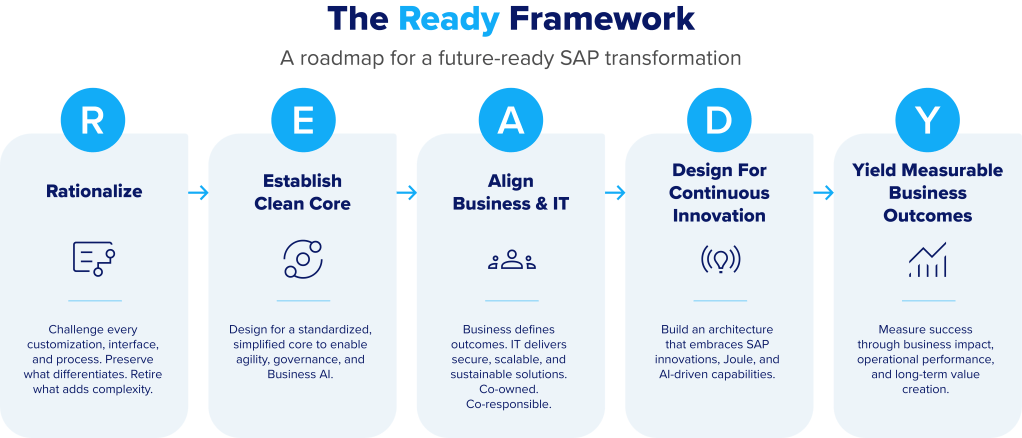
Rather than evaluating migration strategies solely by implementation effort, executive teams should assess them against a single overarching question: Will this migration make the enterprise more adaptable over the next decade?
To answer that, we recommend evaluating migration decisions through the READY Framework:
Measuring Success Beyond Go-Live
A successful migration isn’t defined by completing a project on time or within budget. Those metrics measure delivery, not business value. For executive teams, success should be evaluated through outcomes that matter to the business.
| Executive | Success looks like |
| CIO | Reduced technical debt, faster upgrades, stronger security posture, simplified integrations, AI-ready architecture |
| COO | Standardized global processes, improved operational resilience, faster acquisition integration, higher process efficiency |
| CFO | Lower total cost of ownership, improved governance, reduced operational risk, stronger return on technology investments |
When migration decisions are tied to these outcomes, SAP S/4HANA becomes a platform for business transformation rather than simply another ERP implementation.
Business Value Is Created After Go-Live
Go-live is often treated as the finish line. In reality, it marks the beginning of realizing business value.
Without disciplined governance, proactive optimization, and a modern operating model, even technically successful migrations can struggle to deliver the expected benefits.
Sutherland partnered with a global print and logistics provider to transform a fragmented SAP support environment spanning BASIS and ABAP operations. By consolidating multiple vendors into a unified operating model, the organization achieved a 50% improvement in system efficiency, 100% SLA compliance, and successfully remediated more than 25 critical security vulnerabilities.
Although this engagement focused on SAP operations rather than migration itself, it reinforces a broader lesson:
Modernizing ERP is only half the journey. Sustained business value comes from continuously optimizing how the platform is operated, governed, and evolved.
This operating discipline becomes even more important as organizations begin introducing Business AI, autonomous workflows, and continuous innovation into their SAP landscape.
Conclusion: Migration Is the Foundation, Not the Destination
For many organizations, the SAP ECC-to-S/4HANA migration is still viewed as a race against support deadlines. The more strategic perspective is different. Migration is the point at which organizations decide whether their ERP landscape will support the next decade of innovation or constrain it.
The debate shouldn’t begin with Greenfield, Brownfield, or Selective Data Transition. It should begin with a far more important question: Is the enterprise being designed for continuous innovation, Business AI, and autonomous operations?
The organizations that lead over the next decade won’t simply migrate to SAP S/4HANA. They’ll create an ERP foundation that enables SAP Business AI, supports Clean Core, simplifies operations, and continuously adapts to changing business needs.
Ultimately, the most successful SAP ECC-to-S/4HANA migrations won’t be remembered for the implementation approach they chose. They’ll be remembered for the business capabilities they unlocked long after go-live.