





The Evolution of IT Operations Maturity
Digital businesses rely on application availability, performance, and resilience. Traditional support models based on ticket queues and reactive troubleshooting cannot keep up with complex environments spanning microservices, SaaS, and distributed cloud.
IT Operations Maturity
Enterprises evolve through three stages. Sutherland UnifiedOps supports this progression:
- Gen-1: Manual and Reactive
Operations rely on human intervention and siloed tools. Issues are detected after impact, with limited visibility and high effort. - Gen-2: Automated but Reactive
Automation and AIOps improve response times, but operations remain reactive and decision-making is still human-driven. - Gen-3: Predictive and Autonomous
AI drives operations with predictive insights, automated actions, and self-healing systems aligned to business outcomes.
UnifiedOps enables the shift to Gen-3 by combining observability, automation, governance, and FinOps into a closed-loop model. It improves resolution speed, user experience, and operational efficiency while reducing complexity.
Core Capabilities
Unified Intelligence Fabric
One semantic layer for telemetry, topology, business context, and cost signals – eliminating tool silos.
Agentic ITSM
AI agents for auto-triage, summarization, RCA hints, resolution steps, user conversations, and auto-approval for low-risk changes.
AIOps & RCA Acceleration
Probabilistic correlation, causality graphs, version/change impact scoring, and pattern mining for “recurring unknowns.”
Autonomous Automation
Tiered runbooks—detect → diagnose → remediate → rollback—integrated with approvals and evidence capture.
SRE Practices
SLOs, error budgets, incident command, post-mortems with action automation, resilience drills.
Governance & Risk
Policy-as-code, segregation of duties, continuous controls testing, audit-ready evidence.
FinOps by Design
Cost KPIs woven into every change; optimization “bots” propose/execute safe savings.
DevSecOps Integration
SDLC signals (deploys, feature flags, quality gates) feed AIOps; change risk scored before release


Redefining IT Ops in the Age of AI
UnifiedOps is implemented as a six-layer, closed-loop architecture -from Infrastructure AI and Service Intelligence to Observability, Automation & Resilience, Governance & Business Alignment, and the Autonomous Enterprise layer – ensuring context-aware insights translate into safe, policy-aligned actions at scale.
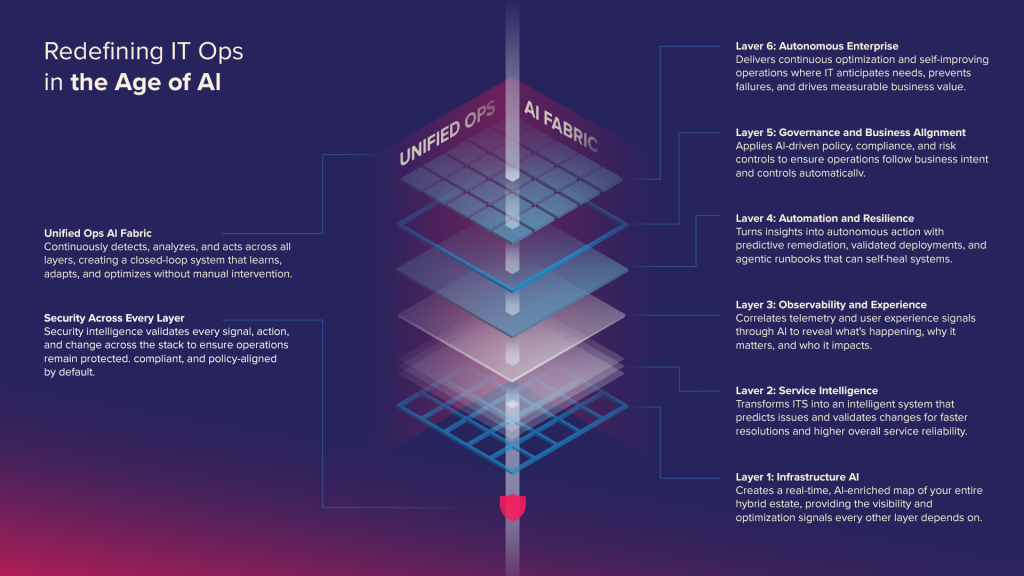
Layer 1
Infrastructure AI establishes full visibility by unifying discovery, CMDB, topology, performance, and capacity insights across hybrid and multi-cloud. This eliminates blind spots and provides the operational baseline needed for a higher maturity level (e.g. Sutherland Gen-3 maturity level)
Layer 2
Service Intelligence enhances ITSM by embedding intelligence into incident, problem, and change workflows. Instead of manual triage, service operations become insight-driven, with faster resolutions and fewer SLA risks.
Layer 3
Observability & Experience correlates logs, traces, metrics, and user signals to deliver clearer understanding of system behavior and user impact. This reduces false positives and accelerates RCA across modern, distributed architectures.
Layer 4
Automation & Resilience converts insights into reliable action. Predictive incident handling, auto-healing runbooks, cloud rightsizing, and validated DevSecOps pipelines reduce noise, MTTR, and operational effort.
Layer 5
Governance & Business Alignment applies policy-as-code, compliance automation, and cost guardrails to ensure operations remain predictable, secure, and aligned to business priorities.
Layer 6
Autonomous Enterprise – shifts IT from reactive maintenance to proactive value creation. This is achieved through predictive, self-healing operations and ongoing experience optimization
Our Solutions
To help organizations adopt this Gen-3 model in a structured, modular way, UnifiedOps is supported by a set of sub-offerings:
IT Operations / ITSM Maturity Assessment – Benchmarking processes, telemetry, tooling, CMDB/topology, automation, SRE maturity, CloudOps posture, and FinOps controls – resulting in a maturity roadmap (e.g., Sutherland Gen-3 maturity level roadmap) with prioritized quick wins and a 60-90-180 day plan.
DevSecOps Consulting – Modernization of CI/CD pipelines, environment provisioning, SBOM and IaC checks, and risk-aware releases to improve deployment frequency and reduce change failure rate.
Agentic ITSM – AI agents for triage, summarization, knowledge generation, and execution of low-risk remediations integrated into ServiceNow/JSM workflows.
Custom applications often power critical business processes and customer experiences. UnifiedOps ensures these applications operate with high availability, performance, and resilience across hybrid and cloud-native environments. The service provides end-to-end operational management covering application monitoring, incident and problem management, release coordination, performance optimization, and operational automation.
By integrating observability, AI-driven analytics, and automation into the application lifecycle, organizations gain proactive insights into application health and user experience. This enables faster root cause identification, predictive issue prevention, and continuous improvement of application reliability without increasing operational overhead.
Enterprise platforms such as ERP, CRM, and industry-specific packaged solutions form the backbone of business operations but require specialized operational management. UnifiedOps delivers structured operations support for enterprise applications by combining platform expertise with standardized ITSM processes and automation-led operational workflows.
The service ensures stable performance, streamlined patching and upgrades, proactive monitoring, and seamless integration with enterprise IT operations. With AI-driven insights and service intelligence embedded into support processes, organizations can maintain business continuity while improving system performance, compliance, and operational efficiency.
Digital products and SaaS platforms demand an operations model that supports rapid innovation, continuous delivery, and always-on customer experiences. UnifiedOps Product Operations aligns DevOps, SRE practices, and operational governance to support product-led enterprises that rely on high-velocity release cycles and scalable platforms.
Through integrated observability, reliability engineering practices, automated incident response, and service reliability metrics, organizations can maintain platform stability while enabling faster product innovation. This approach ensures digital products remain resilient, scalable, and optimized for evolving customer demands.
Multi-domain telemetry ingestion, noise suppression, anomaly detection, change-aware correlation, capacity forecasting, and automated/self-healing actions to accelerate the shift to Gen-3 operating maturity
Key Outcomes
Significant reduction in MTTD/MTTR with predictive, self-healing operations
IT shifts from a reactive cost center to a proactive, measurable business enabler
20-30% reduction in cloud waste through continuous rightsizing and spend intelligence
50%+ reduction in alerts and near-elimination of false positives through AI-based correlation and triage
Continuous policy enforcement, anomaly detection, and AI-driven risk governance across environments
60-80% of routine operational work handled autonomously, freeing teams for higher-value initiatives
~50% faster RCA with unified observability and correlated signals
30-40% faster change/incident cycles due to predictive intelligence
Continuous performance monitoring and proactive optimization
Automation handles routine support tasks, enabling teams to focus on innovation
Stable, high-performing applications improve customer satisfaction
Visibility and automation help manage modern multi-cloud application environments
Why Sutherland
Functional Squads / Domain Experts
Seamless, value-driven collaboration with your existing IT and business teams.
Industry-leading Innovation
Realize your digital roadmap through our automation and AI-powered operations with our standard platforms.
Zero-cost, Risk-free Migration
Incur zero costs until all workloads are successfully migrated and save 30-40% in total cost of ownership.
Integrated Service Model
Efficient cross-functional collaboration between applications, database, infrastructure, legacy systems, and engineering system teams.
AI Fabric Across Six Layers
UnifiedOps integrates Infrastructure AI, Service Intelligence, Observability, Automation, Governance, and Autonomous Enterprise into one closed-loop system.
Out-of-the-box Integrations
Ensures seamless plug-in with ITSM, cloud, infra, and monitoring ecosystems without vendor lock-in.