
Key Points
- Bolt-on chatbots deflect tickets but leave the queues, handoffs and root causes unchanged.
- An AI orchestration layer connects live knowledge, workflows, automation and human specialists.
- Measure end-to-end resolution rather than deflection, and match AI autonomy to risk and reversibility.
The Chatbot Problem in IT support
At 7:40 a.m., employees at a global insurer start logging in and discover the VPN won’t connect. One by one, they open the IT chatbot. It suggests a system restart, shares an outdated troubleshooting article, apologizes, and opens a ticket. By 8:30, the queue holds hundreds of identical tickets. Agents work through them individually, re-asking the same questions, until someone finally connects the dots: a certificate policy pushed overnight broke remote access for 300 users.
The AI dashboard records most of those interactions as “deflected.” The business records a lost morning.
This is the quiet failure of first-generation AI in IT support. The front door got smarter. Everything behind it stayed the same.
The Bolt-on Bot Problem
Many enterprises modernized the fastest visible way: a conversational chatbot interface on top of their existing ITSM platform. But a chatbot that can only talk is just a new way to wait. It can’t see the device, doesn’t know about last night’s change, can’t run the fix, and can’t recognize that one complaint is really a pattern. The work still flows through the same queues and handoffs. The organizations pulling ahead have made a different architectural choice.
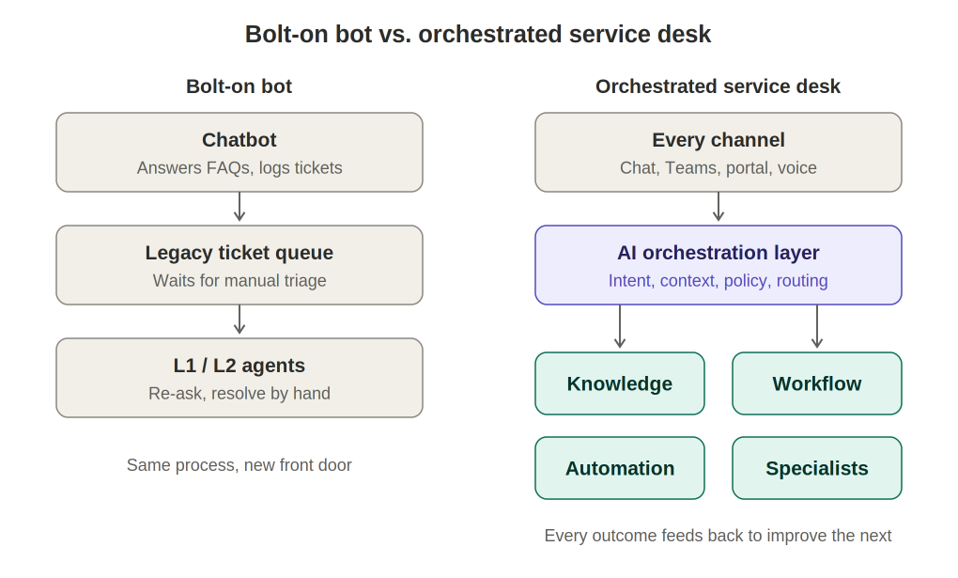
Implement AI as an Orchestration Layer, Not Just a Conversational Interface
In an intelligent IT service management model, the conversation is the least interesting part. What matters is the layer underneath: an AI orchestration layer that understands intent, gathers context users shouldn’t have to supply multiple times, decides what should happen next in an autonomous way, and coordinates whichever capability is best placed to act on time to minimize any downtime.
That layer connects four things that have historically lived in silos. Live or real-time access to knowledge repository tells it what’s true right now. Workflow provides approved paths for request processing and changes. Automation lets it reset, provision, restart, and renew. Human specialists remain the destination for judgment, reached with full context rather than a cold handoff.
Enterprise Use Cases Across Industries: What Changes Behind the Bot
Use case 1 | Insurance: remote-access failure at scale
Replay the insurer’s morning on an orchestrated architecture. The first report triggers a context check across device health, recent changes, and open incidents. The system matches a known pattern, fixes affected users automatically, and alerts a production support engineer to resolve the root cause for everyone.
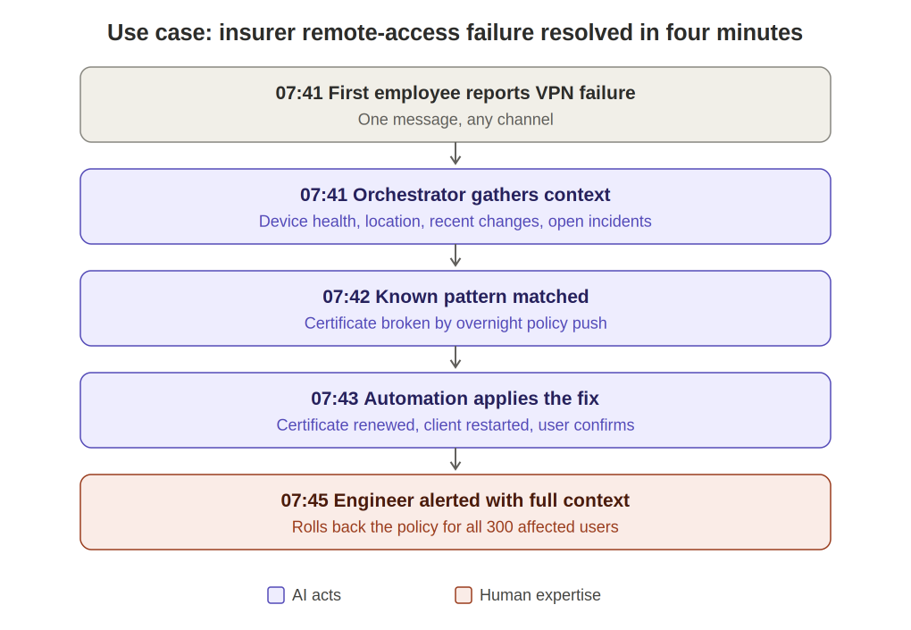
Most affected employees never notice there was a problem, and the service desk handles one incident instead of creating hundreds of tickets. That is the difference between automated deflection and autonomous resolution.
Use case 2 | Banking: onboarding at scale
A retail bank onboards hundreds of branch and contact center staff ahead of peak season. Traditionally, each hire triggers a chain of tickets across HR, identity, hardware, and application owners. With orchestration, the HR record launches one role-based workflow: standard access is provisioned automatically, approvals for regulated applications run in parallel, and devices arrive pre-configured. New hires are productive on day one, and every access grant is logged for audit.
Use case 3 | Payments: the overnight major incident
A payments provider’s gateway fails at 2 a.m. Here AI does not take the wheel. It correlates alerts, suppresses duplicate tickets, pulls the runbook, drafts client communications, and assembles the incident bridge with on-call engineers already briefed. Humans take more strategic and business critical decisions here including whether to fail over or roll back. AI ensures they spend the first minutes fixing rather than finding, then drafts the post-incident timeline.
Use case 4 | Healthcare: the request that should pause
A contractor at a healthcare provider requests access to a repository containing patient data. Automation could grant it in seconds, which is exactly why it shouldn’t. The orchestration layer recognizes the data classification in terms of sensitivity, checks the contractor’s agreement, and routes the request to the data owner with a recommendation. Speed matters, but compliance matters more.
Use case 5 | Manufacturing: keeping the plant floor running
At a manufacturer, a scanner failure on a production line isn’t an inconvenience; it’s lost output. The orchestration layer recognizes the device, the line it serves, and the shift schedule, then prioritizes accordingly. It pushes a known configuration fix remotely, and if that fails, dispatches an on-site technician with diagnostics, the asset history, and a replacement unit already reserved.
Where Should AI Act Alone, and Where Should Humans Stay in the Loop?
Each use case turns on one design question: how much autonomy should AI have for this kind of work? The answer is a spectrum, calibrated by risk, reversibility, and the need for judgment.
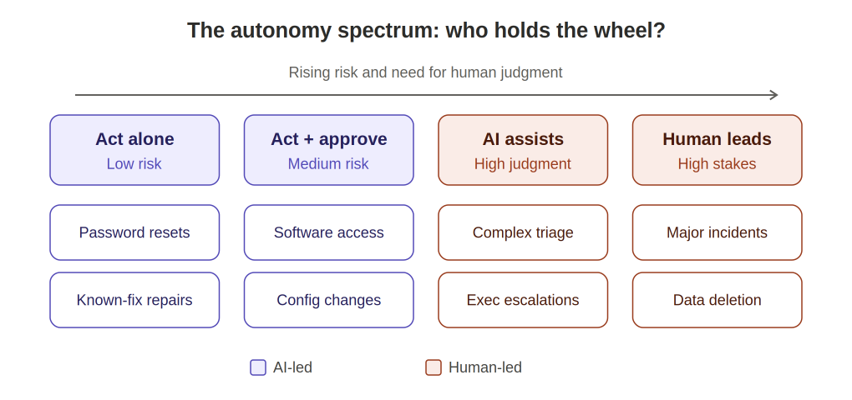
AI should act independently where work is high-volume, well understood, low-risk, and easily reversed: password resets, account unlocks, known-fix repairs, and routine provisioning. Forcing human approval here isn’t caution; it’s friction.
AI should act with a human checkpoint where the action is routine but consequences are real, such as access to licensed or regulated applications and configuration changes. The AI prepares everything, and a person confirms.
Humans should stay firmly in the loop wherever situations are novel, ambiguous, or high-stakes: major incidents, security events, data deletion, and executive escalations. AI becomes the specialist’s best assistant, while accountability stays with people. As automations prove themselves, work can move along the spectrum deliberately, with evidence.
Designing an End-to-End Intelligent Support Architecture
An AI-powered IT support architecture that changes outcomes has five layers working together.
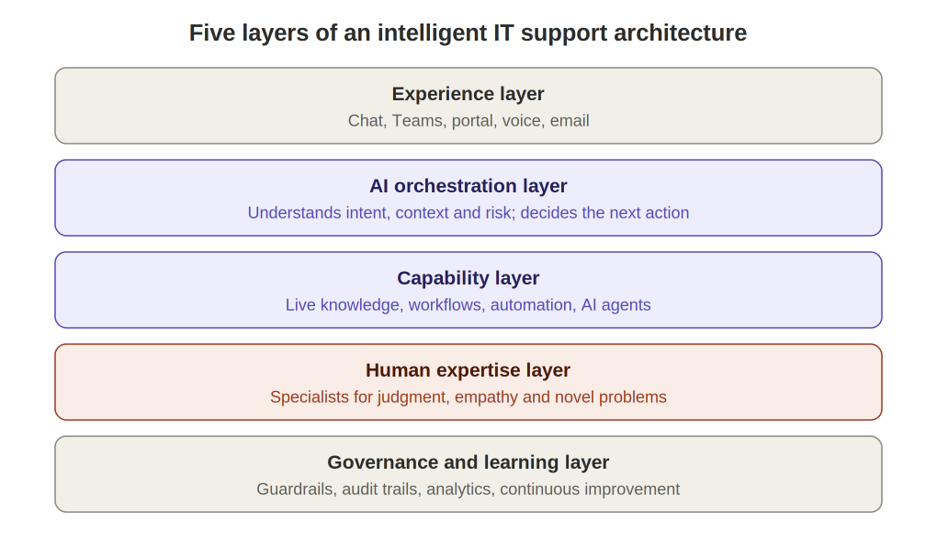
The experience layer meets employees wherever they already work. The orchestration layer is the brain, classifying intent, enriching requests with identity, device, and change data, scoring risk, and choosing the path. This is where most design effort belongs, and where bolt-on implementations invest least.
The capability layer gets work done through live knowledge, workflows, automation, and AI agents that handle multi-step tasks end to end. The human expertise layer is designed in from the start, so escalations arrive with a summary and recommended next action. The governance and learning layer keeps everything honest: autonomous actions are logged and explainable, guardrails define when AI must stop, and every resolution feeds better knowledge and new automation.
Measure Resolution, Not Deflection
Deflection usually rewards a bot for ending conversations, whether or not the problem was solved completely. Better measures focus on business impact: end-to-end resolution time, automated fixes that stay fixed, specialist time spent on complex work, audit readiness, and how quickly recurring issues are eliminated at the root.
The Bot Was Never the Point
The next generation of enterprise IT support won’t be defined by how human the chatbot sounds. It will be defined by what happens in the minutes after someone reports that something is broken.
At Sutherland, we have seen that the biggest gains come from redesigning the operating model, not the interface. We start from the outcomes the business needs and design backward, combining AI orchestration, intelligent automation, and the human expertise that complex moments still demand. If your service desk has a new front door but the same old hallway behind it, it’s time to redesign what happens behind the bot.
At Sutherland, we believe the future of enterprise IT support lies in connecting Agentic AI, intelligent automation, and human expertise into one continuously improving service model. By moving beyond reactive ticket management toward predictive, autonomous, and experience-led operations, enterprises can reduce disruption, accelerate resolution, and create a more resilient digital workplace.
Click here to explore our AI-powered digital workplace services that can transform enterprise IT support from reactive issue resolution into autonomous, predictive, and experience- centric operations.