
Key Points
- Mystery audits assess real customer interactions against defined service, compliance, and brand standards.
- Findings can reveal inconsistent service, process gaps, and training needs across locations and channels.
- Clear evaluation criteria and constructive feedback turn audit results into practical improvements.
What if you could see your business exactly the way your customers do? Mystery audits make that possible by providing an unbiased view of an organization’s service quality, compliance, and customer experience through the eyes of an ordinary customer. This makes them useful for identifying gaps that may otherwise go unnoticed.
A mystery audit is conducted anonymously by trained mystery auditors who pose as regular customers. They evaluate staff behavior and product knowledge, store ambience, product availability, service quality, response time, and adherence to internal standards and operating procedures.
Since employees do not know when they are being assessed, the results tend to reflect genuine day-to-day performance rather than rehearsed or staged behavior. However, mystery audits should not be confused with customer satisfaction surveys. While mystery audits evaluate actual service delivery against predefined brand standards and operational requirements, customer satisfaction surveys focus on capturing customers’ perceptions, experiences, and overall sentiment regarding the service they received.
According to Market Intello, mystery audits have become $2.8 billion industry in 2025, and the industry is expected to reach $5.1 billion by 2034 at a CAGR of 6.9%
Mystery Audits Across Customer-Facing Businesses
Mystery audits are widely used across various industries to evaluate various parameters.
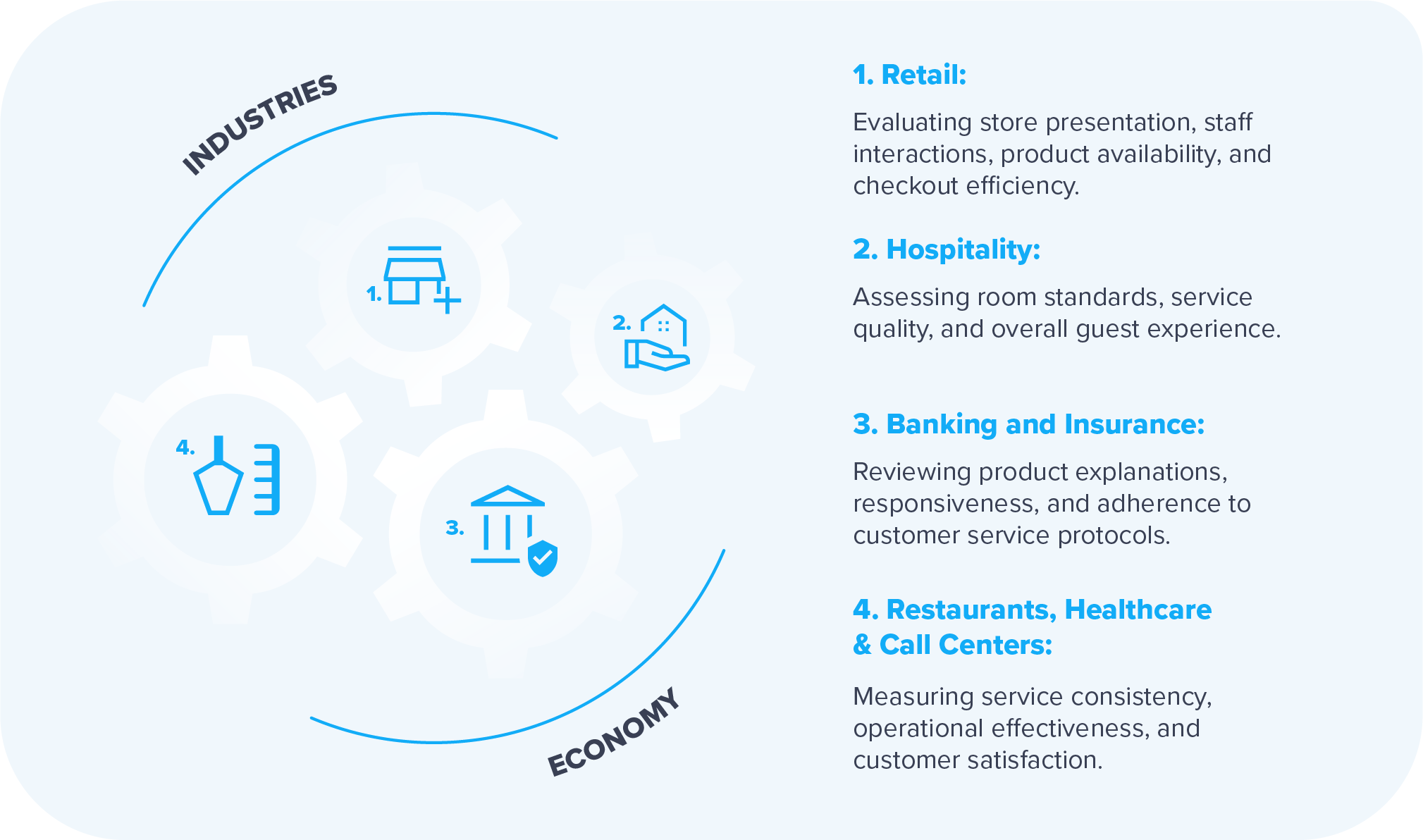
According to Market Intello study, Retail is the largest consumer of mystery audit services.
Across all sectors, the objective remains the same: to determine whether the customer experience delivered matches the brand promise.
Why Mystery Audits Matter?
The goal of mystery audit is not to catch people off guard, but to provide honest insights that can help improve service delivery.
Unlike traditional audits that focus on documents and processes, mystery audits focus on actual customer interactions. They help businesses see whether policies are truly being followed in practice.
Some of the key benefits of mystery audit services for businesses are outlined below. The challenges identified broadly represent the areas where Sutherland has helped clients uncover issues, improve performance, and enhance customer experience.
| Benefit Area | How It Helps | Challenges Identified by Sutherland |
|---|---|---|
| Customer Experience | Improves service quality through real-world feedback. | Bank customers faced excessive paperwork, multiple counter hopping, and delays due to staff shortages and complex processes. |
| Employee Performance | Supports targeted training and coaching. | Untrained staff lacking skills caused multiple customer visits and delays as employees frequently consulted superiors on products and processes. |
| Compliance | Ensure policies and standards are followed. | Some financial outlets charged unauthorized fees and imposed unfair conditions, resulting in SOP violations. |
| Operational Efficiency | Identifies process gaps before they escalate. | Inadequate technology, infrastructure, and security measures drove operational delays, heightened security risks, and compromised confidentiality. |
| Customer Journey Insights | Reveals customer pain points and service gaps. | Poor handoffs, confusing processes, inconsistent staff experiences and poor client engagement. |
| Accountability | Monitors service standards consistently. | Lack of ownership, weak performance monitoring. |
| Benchmarking | Compares performance across locations and tracks progress. | Performance variations, inconsistent customer experiences, lack of benchmarks. |
Why Are Organizations Increasingly Investing in Mystery Audits?
Organizations often invest in mystery audits when they:
- Want to improve customer experience (CX) by understanding how customers actually experience their products, services, and frontline interactions.
- Manage omnichannel customer journeys and need to ensure consistent experience across physical locations, websites, mobile apps, contact centers, and other touchpoints.
- Need to strengthen compliance and quality standards, particularly in highly regulated industries such as banking, healthcare, automotive, and retail.
- Seek data-driven insights to identify service gaps, operational issues, and opportunities for improvement before they impact customers.
- Want to leverage technology-enabled auditing, including AI, video analytics, and mobile assessment tools, to obtain faster and more actionable feedback.
- Need a complete view of performance by integrating mystery audit findings with CRM, POS, and customer feedback data to support better decision-making.
Partner with Sutherland to Achieve Your Mystery Audit Goals
Sutherland offers bespoke Mystery Audit Programs designed to objectively evaluate customer experience, policy compliance, and brand standards across your customer touchpoints. Our approach transforms real customer interactions into actionable insights that help organizations improve service quality, strengthen compliance, and drive measurable business outcomes.
How Do We Deliver Value?
- We Understand Your Business
We begin with a diagnostic consultation to understand your customer journeys, service standards, operational processes, and business objectives. This enables us to define clear audit goals, KPIs, and success metrics. - Design a Tailored Audit Framework
Based on your requirements, we develop customized audit checklists, scoring models, and evaluation criteria aligned with your brand guidelines, SOPs, and compliance requirements. - Conduct Mystery Audits
Our trained evaluators pose as real customers—visiting stores, making calls, or interacting online—and assess the experience against predefined criteria, without disrupting day-to-day operations. - Deliver Actionable Insights and Drive Improvement
Following each audit cycle, we provide consolidated reports featuring performance scores, service gaps, compliance issues, supporting photo evidence, and prioritized recommendations. We work with stakeholders to translate findings into practical action plans.
This end-to-end approach gives organizations a realistic view of the customer experience while enabling continuous improvement across service delivery, employee performance, operational efficiency, and compliance.
Conclusion
Mystery audits give businesses a real-world view of their service quality and customer experience. They uncover gaps, reinforce standards, and help leaders make informed improvements. In a competitive market, this visibility can make a meaningful difference.
To get the most from mystery audits, businesses should design them carefully. The audit checklist should be specific, measurable, and aligned with business goals. Auditors should be trained to observe objectively and report facts rather than opinions.
It also helps to use the findings constructively. Mystery audits should be treated as a development tool, not a punishment mechanism. When teams see that the purpose is improvement, they are more likely to engage positively with feedback.

Vikas Verma

Vivek Gupta