
Key Points
- The growth of the RIA operating model is strong, but execution is straining as AUM/client growth outpaces operating capacity, especially in mid-sized firms.
- Market complexity and shifting client expectations are changing the conversation from backward-looking performance to forward-looking positioning, risk trade-offs, and clear explanations.
- The real constraint is advisor productivity and research translation at scale, turning institutional research into consistent, client-ready insight without adding headcount.
Registered Investment Advisors (RIAs) are independent wealth-management firms that provide investment advice and financial planning under a fiduciary standard, meaning they are legally required to act in clients’ best interests. Most earn fees based on assets under management (AUM), aligning their growth with client portfolio growth.
Serving high-net-worth individuals and families, RIAs have been one of the fastest-growing segments in financial services over the past decade.
Growth has rarely looked stronger. Yet rising market complexity and shifting client expectations are exposing execution limits inside many mid-sized firms. As firms scale, advisor productivity and research translation — not performance — are emerging as the real constraints.
Strong RIA Growth Masks Emerging Operating Strain
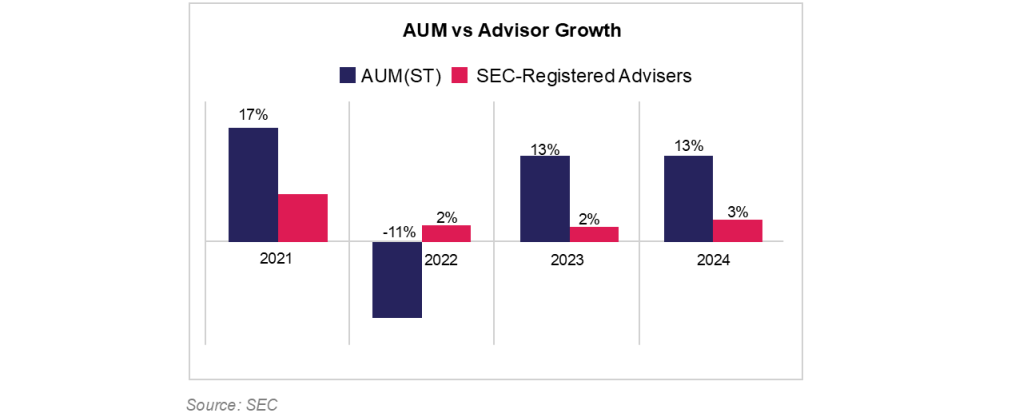
The RIA model continues to expand rapidly, supported by strong organic growth in both assets and clients. According to recent editions of the Schwab RIA Benchmarking Study, AUM grew by approximately 16–17% in 2024, alongside high-teens revenue growth and steady increases in client counts. According to the 2025 Investment Adviser Industry Snapshot, the number of SEC-registered RIAs rose to 15,870 in 2024 (a ~3.1% increase), while clients served climbed to 68.4 million (up ~6.8% year-over-year)—clear evidence that demand for fiduciary advice remains robust even amid broader market uncertainty.
However, this growth is unfolding in a markedly different operating and market environment than in prior cycles—one that is placing new demands on advisors and internal teams.
A More Complex and Uncertain Market Environment
Despite strong headline returns, frequent regime shifts driven coupled with higher interest rates, elections, and geopolitics have weakened the reliability of traditional risk-return relationships, making diversified portfolio outcomes more difficult to contextualize using conventional benchmarks.
This was evident in 2025, when market data shows continued instability: equity correlations have shifted, with U.S. equities decoupling from global peers, while fixed-income volatility spiked, as reflected in elevated levels of the ICE BofA MOVE Index, even as equities remained resilient. Together, these dynamics have pushed advisor-client conversations away from backward-looking performance toward portfolio positioning, risk trade-offs, and forward-looking rationale.
For RIAs, this has translated into:
- Sharper short-term market swings, even during broadly positive market periods
- Greater dispersion across asset classes and strategies, complicating portfolio explanations
- Meaningful shifts in fixed-income outcomes, as expectations around rate paths changed repeatedly
Traditional risk-return relationships—especially in diversified, multi-asset portfolios—have become harder to explain using simple benchmark narratives. As a result, client conversations increasingly focus on positioning, risk trade-offs, and forward-looking rationale, rather than performance alone.
Client Expectations Are Evolving Rapidly
Against this backdrop, client expectations have shifted decisively.
Both the Schwab RIA Benchmarking Study and Cerulli Associates’ advisor and practice-management research show that clients increasingly value:
- Holistic, goals-based advice, rather than portfolio management in isolation
- Clear, plain-language explanations of portfolio decisions and changes
- More frequent and proactive communication, particularly during periods of market stress
Generic quarterly reviews and static performance reports are no longer sufficient. Instead, advisors report that client conversations are increasingly driven by questions such as:
- What changed in my portfolio, and why?
- How does this positioning manage risk in the current environment?
- What should I be thinking about between meetings?
These expectations are especially pronounced as wealth transitions to younger generations, who expect higher transparency, ongoing explanation, and a more interactive advisory experience.
That is why this conversation matters right now.
Why Are Mid-Sized RIAs Facing a Structural Capacity Constraint?
Schwab’s RIA Benchmarking Study and Cerulli Associates’ advisor research highlight a clear shift toward comprehensive wealth-management models, where advisors are expected to combine portfolio management, financial planning, client communication, and ongoing explanation. As firms scale, this expanded mandate places increasing pressure on advisor capacity.
While client demand remains strong, the internal operating models of most mid-sized RIAs have not scaled proportionately. Schwab benchmarking data shows that AUM growth has consistently outpaced headcount growth, particularly within the mid-market segment. Advisors continue to manage 30–40 core client relationships, while research and investment teams remain deliberately lean and focused on portfolio construction, asset allocation, manager selection, and investment governance.
Where capacity breaks down:
- Personalized engagement does not scale linearly as advisor books grow, forcing greater reliance on standardized reports even as client questions become more specific
- Meeting preparation becomes a productivity bottleneck, with advisors duplicating effort across similar portfolios and review cycles
- Research insights remain locked in institutional materials, designed for governance and decision-making rather than repeated client-level customization
- Client experience becomes inconsistent across advisors, driven by differences in preparation, support, and confidence
Adding headcount to support deeper engagement is costly, slow, and often dilutive to margins, especially amid elevated compensation and operating costs. As a result, growth is increasingly constrained not by demand or investment capability, but by the firm’s ability to translate complex research into clear, consistent, client-ready insight at scale. Firms that fail to do so risk pressure on client confidence, retention, referrals, and Net Promoter Scores (NPS)—even when performance remains competitive.
The Next Phase of RIA Growth
Looking ahead, the next phase of RIA growth will be defined less by investment outcomes and more by how effectively firms scale insight, explanation, and engagement. As portfolios grow more complex and clients demand greater clarity, advisor productivity and research translation will become structural advantages, not operational details. RIAs that modernize how research is delivered to advisors and clients will be better positioned to sustain growth, deepen relationships, and differentiate in an increasingly competitive advice landscape.
Driving Client Confidence: How SGS Strengthens RIA Delivery
At Sutherland, we help RIAs turn investment insight into scalable AUM growth by translating complex research into advisor-ready and client-ready communication. Our domain-led teams support the full RIA lifecycle—from investment research and portfolio analytics to client reporting, investment oversight, and growth enablement.
AI accelerates data processing, standardization, and workflow efficiency, while our investment specialists ensure outputs remain accurate, consistent, and fiduciary-aligned. The result is higher advisor productivity, clearer client communication, and the ability to scale engagement without adding headcount.