
Key Points
- T.R.U.S.T. is Sutherland Mortgage’s operating system, built to give lenders end-to-end confidence across origination, underwriting, servicing, and capital markets—far beyond traditional outsourcing.
- The framework responds directly to 2025–26 market realities—tightening regulation, talent shortages, rising costs, and borrower expectations by grounding operations in AI, compliance, and deep domain expertise.
- Mortgage leaders gain measurable performance certainty through transformative AI, embedded risk control, underwriting depth, servicing excellence, and transparent governance—delivering lower costs, faster cycle times, and zero-defect compliance.
In 2025, mortgage leaders in the United States are navigating one of the most unforgiving environments the industry has ever encountered. Elevated interest rates are strangling refinance activity and subjecting the purchase market to intense price pressure.[1] At the same time, operating costs and compliance demands continue to climb, forcing lenders to squeeze more efficiency out of every process and every person.[2]
The squeeze on servicers is identical. Leadership takeaways are explicit: servicing shops that don’t actively invest in AI-driven automation and compliance tooling will struggle to keep up with investor expectations and regulatory scrutiny.[3]
Add to that a borrower base that now expects digital speed and human empathy, and you have an industry where a single bad interaction can undo years of relationship-building. Digital transformation in mortgages “is no longer a choice but a necessity” for anyone who wants to stay competitive.
In this context, trust isn’t a soft concept. It’s a hard performance requirement.
Why “Trust” Needed a New Definition in Mortgage
Suppose you ask most lenders what keeps them up at night in 2025. In that case, the answers sound familiar: margin compression, regulatory risk, tech debt, talent gaps in underwriting, and rapidly rising expectations around digital experience.
But underneath those issues is something more profound:
- Can I trust my data, workflows, and partners to be right every time?
- Can I trust that AI won’t introduce new risks even as it removes manual work?
- Can I trust that my operating model can flex when the market whiplashes again?
Traditional outsourcing and point AI solutions don’t fully answer these questions. They often optimize pieces of the mortgage lifecycle— processing here, contact center there— without giving executives end-to-end confidence that risk, compliance, and experience are designed into the system.
That gap is why Sutherland created the T.R.U.S.T. framework for mortgage. It’s not a tagline; it’s an operating model built to embed trust into how mortgages are originated, underwritten, serviced, and sold.
What T.R.U.S.T. Means in a Mortgage Context
T.R.U.S.T. stands for:
- Transformative AI
- Risk-Aware Operations
- Underwriting-Deep Expertise
- Servicing-Centered Delivery
- Transparent Governance
Learn more about the TRUST Framework>
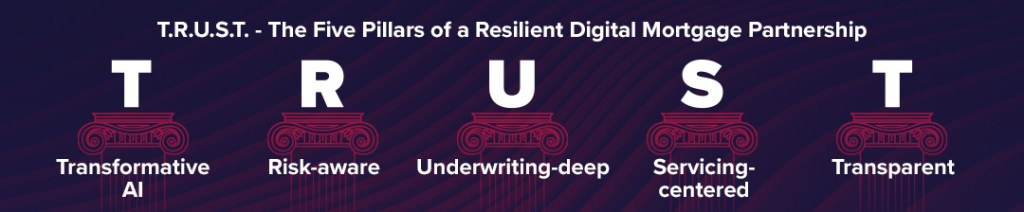
Each pillar is a response to specific shifts we’re seeing in the US mortgage market.
T — Transformative AI
In 2025, most lenders have already automated something— document ingestion, some LOS workflows, basic bots. However,the next wave is about AI that is embedded in decisioning, not bolted on the side.
Industry observers note that AI and machine learning are already transforming underwriting and processing: reducing approval times, improving data accuracy, and shrinking the traditional 30–45-day cycle.
In the T.R.U.S.T. framework, Transformative AI means using AI agents, intelligent document processing, and knowledge engines to: pre-clean and classify loan files, guide underwriters to the riskiest or most material items first, and automate repeatable servicing and QC checks.
The goal is not to replace underwriters or servicers, but to amplify their judgment and reduce the cognitive load of low-value work. That’s how Sutherland is able to digitize a large portion of mortgage operations, enabling 30–40% faster underwriting and onboarding cycles.
R — Risk-Aware
Regulation isn’t easing; if anything, it’s tightening. Commentary from MBA policy and compliance forums in 2025 highlights increasing focus on fair lending, third-party oversight, model risk management and operational resilience.
In this environment, you can’t treat compliance as a layer on top of operations. Risk-Aware in T.R.U.S.T. means:
- workflows designed with regulatory logic from day one,
- controls that are monitored continuously rather than periodically, and
- coverage across all 52 US jurisdictions plus territories for licensing and servicing.
Sutherland’s mortgage teams operate with a zero-buyback record across key portfolios, backed by automated pre-purchase reviews, HMDA and TRID checks, and investor-grade audit trails.
That’s what “risk-aware” needs to look like in 2025 and beyond.
U — Underwriting-Deep
Analysts covering lending operations note that service providers are increasingly differentiating themselves through domain-led models, not just labor arbitrage. Underwriting is a prime example. As products become more complex—Non-QM, expanded-credit borrowers, layered risks—depth of judgment matters as much as speed.
Underwriting-Deep in T.R.U.S.T. means:
- one of the largest pools of CRU-certified underwriters,
- 15+ years of experience across Conventional, FHA, VA, and Non-QM loans, and
- workflows that combine credit expertise with digital guardrails.
In practice, that looks like digital playbooks, scenario-driven work queues, and AI prompts that help underwriters ask better questions, not fewer.
S — Servicing-Centered
The servicing side of the house is under particular strain in 2025: higher delinquencies in some segments, more complex loss-mitigation paths, and borrowers expecting Amazon-level digital experiences.
Servicing-Centered in T.R.U.S.T. means designing operations around the lifetime borrower relationship, not just the monthly statement:
- Conversational AI that resolves routine queries and frees agents for high-emotion, high-risk interactions,
- Integrated views of borrower history across channels, and
- BPaaS models that flex capacity as cycles change without compromising empathy.
The result is measurable: Sutherland’s servicing programs have delivered 30%+ call deflection rates and double-digit improvements in borrower satisfaction while reducing handling time and cost-to-serve.
T — Transparent Governance
Finally, there’s the trust that matters to every US mortgage CXO: can I see, measure, and control what’s happening across my extended operating model?
In surveys of lenders’ priorities for 2025, Fannie Mae found that executives are heavily focused not just on eMortgage adoption but on how technology investments tie directly to business outcomes.
Transparent Governance in T.R.U.S.T. delivers:
- Real-time dashboards covering SLAs, quality, risk, and customer metrics,
- Clear ownership and escalation paths across onshore, nearshore, and offshore teams, and
- Joint steering that links transformation roadmaps to P&L and risk objectives.
Transparency is how trust is maintained over years, not quarters.
Learn more about the TRUST Framework
Why Sutherland Built T.R.U.S.T.—And How It’s Different
Sutherland did not create T.R.U.S.T. as a marketing device. It emerged from two decades of working inside lenders’ most critical operations and seeing the same pattern repeat:
- Technology projects that delivered tools but not behavior change,
- Outsourcing engagements that were efficient but opaque,
- Transformation programs that never quite connected CX, risk, and cost outcomes.
T.R.U.S.T. is our way of hard-coding what works. It’s different from typical provider “frameworks” in three ways:
- It’s end-to-end, not point-based.
T.R.U.S.T. spans origination, servicing, and capital markets, tying AI, domain expertise, and governance together so leaders can trust the whole journey, not just one function. - It’s outcome-anchored.
Our mortgage programs are structured around metrics like 35%+ reduction in origination cost, 30–40% faster onboarding, and 100% compliance with zero buybacks—not just FTE savings. - It’s built for AI-first transformation.
Many frameworks still assume humans as the default and automation as the add-on. T.R.U.S.T. starts with AI as the fabric—agentic orchestration, intelligent documentation, predictive analytics—and then designs human roles where judgment, empathy, and exception handling matter most.
Learn more about the TRUST Framework>
What This Means for US Mortgage Leaders
If you’re leading a mortgage business in the US today, you’re likely asking yourself how to:
- Rebuild margin without sacrificing experience,
- Adopt AI responsibly without inviting new risk, and
- Modernize your operating model without disrupting day-to-day performance.
The T.R.U.S.T. framework is Sutherland’s answer to those questions. It’s a practical way to operationalize trust—across systems, partners, and people—so that every decision, every loan, and every interaction is more resilient than the one before.
In a market where digital mortgages, AI underwriting, and omnichannel servicing are quickly becoming table stakes, the real differentiator is whether your ecosystem is truly trustworthy. That’s the standard T.R.U.S.T. is designed to meet.
Explore the T.R.U.S.T. Framework

References
- Baker Tilly, “Key insights for the mortgage industry heading into 2025,” 2025.
- BCG & MBA, “US Mortgage Performance Report,” 2025.
- Vaultedge, “Mortgage servicing in 2025: optimizing efficiency, compliance, and risk management,” 2025.
- Orchestrate, “Revolutionizing mortgage processing in 2025: how technology is leading the way,” 2025
- Everest Group, “Lending Services Operations PEAK Matrix® Assessment 2024”
- Fannie Mae, “Mortgage Lender Sentiment Survey® – eMortgage adoption and business priorities for 2025,” Aug 2025.